Key Takeaways
- Lifting force equals loaded weight × hinge to load centre ÷ hinge to cylinder mount. For an evenly spread load, the load centre is about half the body length. The start of the lift is where the cylinder works hardest.
- Stroke equals hinge to cylinder mount × a dump angle multiplier. At 50 degrees, the multiplier is 0.845.
- Stages extend largest first and smallest last, so the cylinder pushes with less force as each smaller stage takes over. The smallest stage still has to lift what’s left of the load when its turn comes.
- Fit matters as much as force. Stroke and stage count get chosen together, because the collapsed cylinder has to fit between the frame and the body with the box down.
- Single-acting is what dump hoists use. Oil pressure raises the body and gravity lowers it.
To size a telescopic cylinder for a dump truck, you need four numbers: the weight of the loaded body, the length of the body, the distance from the hinge to where the cylinder mounts on the body, and the dump angle you want to reach. Those give you the lifting force and the stroke. From there, you check that every stage can still push hard enough at your system pressure, and that the cylinder fits in the space you have when it’s collapsed.
We’ll walk through each step with a worked example, then give you a spec sheet to fill in before you request a quote. This method is for front-mount telescopic hoists, where the cylinder sits at the front of the body behind the cab. Underbody and scissor hoists use different geometry, so these numbers won’t carry over to them.
Why Dump Trucks Use Telescopic Cylinders
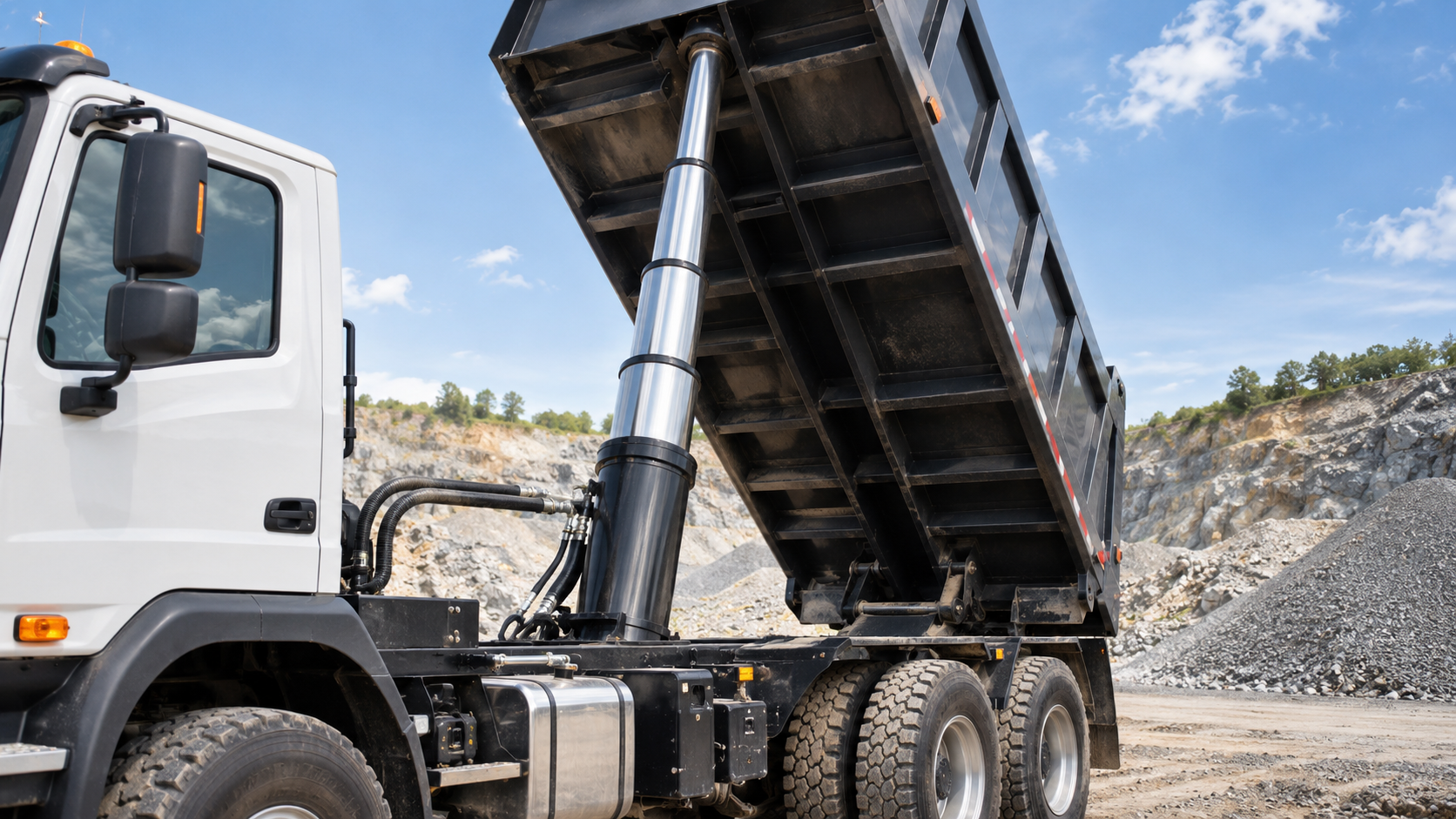
A dump body needs a long push from a cylinder that starts out short. That’s why telescopic cylinders are the most common hoist cylinder on dump trucks. Their stages nest inside each other, so the whole cylinder collapses to a fraction of its extended length. A single-stage welded cylinder with the same stroke would be longer than that stroke even when fully retracted, and it simply won’t fit under the front of a dump body.
Mounting the cylinder at the front of the body also gives it far more leverage. An underbody cylinder starts out lying nearly flat, so very little of its force goes into lifting at first. A front-mount cylinder pushes close to straight up from the start, which is why it can handle heavier loads. Maverick Hydraulics builds telescopic hydraulic cylinders for dump trucks, trailers, snow plows and cranes, starting at two stages.
Dump hoists use a single-acting cylinder. Oil pressure raises the body, and gravity brings it back down.
The Measurements You Need
Take every measurement from pin centres, and keep your units consistent. Inches and pounds work, and so do millimetres and kilograms, as long as you don’t mix them.
- Loaded weight: the payload plus the weight of the body itself. The cylinder lifts both.
- Body length: the length of the dump body. For an evenly spread load, the load centre sits about halfway along it, so you don’t need to measure that separately.
- Hinge to cylinder mount: from the hinge pin forward to where the cylinder attaches to the body.
- Target dump angle: how far the body needs to tip to empty cleanly.
- Collapsed space: the pin-to-pin distance between the frame mount and the body mount with the box down.
- System pressure: the setting on your relief valve.
Step 1: Calculate the Lifting Force
The hardest moment for any dump hoist is the very start of the lift. The full load sits as far from the hinge as it will ever be, and the cylinder has to get it moving. As the body rises, the load moves back toward the hinge and material starts sliding out, so the force needed drops.
Lifting force = loaded weight × hinge to load centre ÷ hinge to cylinder mount
Worked example
Say your loaded body weighs 36,000 lb (about 16,330 kg), counting both the payload and the body. The body is 168 inches long, so the load centre sits about 84 inches ahead of the hinge. The cylinder mounts at the front of the body, 168 inches ahead of the hinge.
- 36,000 × 84 = 3,024,000
- 3,024,000 ÷ 168 = 18,000 lb
The cylinder needs about 18,000 lb of force at the start of the lift. Because the cylinder mounts twice as far from the hinge as the load centre, it only needs half the weight of the load in force. That’s why the cylinder mount position matters so much.
Step 2: Calculate the Stroke
As the body tips up, the point where the cylinder attaches swings in an arc around the hinge. The stroke works out to roughly the straight-line distance between where that point starts and where it ends up, which you can get with a simple multiplier for your dump angle.
Stroke ≈ hinge to cylinder mount × dump angle multiplier
The multiplier is 2 × sin(half the dump angle). For the common angles:
| Dump angle | Multiplier |
|---|---|
| 45° | 0.765 |
| 50° | 0.845 |
| 55° | 0.923 |
| 60° | 1.000 |
Most dump bodies are built to tip somewhere between 45 and 60 degrees. This shortcut assumes the frame end of the cylinder sits roughly below its body mount, which is typical for a front-mount hoist. Treat the result as a planning number. The exact stroke depends on where both mounting points sit, and it should be confirmed from your actual measurements before a cylinder is built.
Worked example
Using the same truck and a target of 50 degrees:
- 168 × 0.845 = about 142 inches of stroke (about 3.6 m)
Now check that it fits. Adding stages lets you get more stroke from a shorter collapsed cylinder, because each stage only covers part of the distance. If 142 inches of stroke won’t fit in your collapsed space with the stage count you’re looking at, you need more stages, a different mount position or a lower dump angle.
Step 3: Check Every Stage at Your System Pressure
This step is specific to telescopic cylinders. The stages extend in order, largest first and smallest last. On most single-acting designs, each stage’s working area is set by its outside diameter, because that’s where it seals against the stage around it. Force is pressure times area, so as each smaller stage takes over, the cylinder pushes with less force at the same pressure.
In practice, the pressure climbs as the lift goes on. The first stage might start the body moving at under 1,000 psi, while the last stage can need more than 3,000 psi, depending on the cylinder and the system. The pressure needed at every stage has to stay below your relief valve setting and the cylinder’s rating.
Stage force = system pressure × 3.1416 × (stage diameter ÷ 2)²
Worked example
Say the cylinder you’re considering has four stages measuring 6, 5, 4 and 3 inches across, and your relief valve is set at 2,500 psi (about 172 bar). These diameters are for illustration only. Here’s the most each stage can push:
| Stage | Diameter | Working area | Most force at 2,500 psi |
|---|---|---|---|
| 1 (moves first) | 6 in | 28.27 sq in | 70,690 lb |
| 2 | 5 in | 19.63 sq in | 49,090 lb |
| 3 | 4 in | 12.57 sq in | 31,420 lb |
| 4 (moves last) | 3 in | 7.07 sq in | 17,670 lb |
At the start of the lift, the first stage only needs about 640 psi to make the 18,000 lb from Step 1 (18,000 ÷ 28.27). The last stage can only make 17,670 lb even at full relief pressure, which is less than the 18,000 lb needed at the start. That’s fine, as long as the body has risen far enough by the time the last stage moves that the force needed has dropped well below what it can make.
Confirming that margin at each stage takes the full geometry of your body and how your load shifts as it tips. It’s the kind of check our in-house engineering team can run for you.
Other Details That Change the Answer
Mounting style
Because the body pivots as it lifts, the cylinder has to pivot too, using a cross tube, trunnion or eye mount. Where those mounts sit changes both your leverage and your stroke, so moving a mount by a few inches can change the cylinder you need. Maverick keeps trunnion and pin-to-pin telescopic cylinders in stock.
Oil volume
A front-mount telescopic cylinder takes a lot of oil to fill at full extension, much more than an underbody hoist. Check that your tank can fill the cylinder all the way out and still keep the pump supplied, so the pump never pulls in air. Air in the oil leads to the kind of pump damage we cover in our post on cavitation.
Ontario winters and sticky loads
Everything above assumes your load slides out as the body rises. Frozen or sticky material that hangs up near the top of a raised box breaks that assumption, leaving weight high in the box while it’s in the air. A raised box with weight stuck high in it is a common setup for a tip-over. Ontario construction safety guidance recommends not leaving loads in dump boxes overnight in winter. A bigger cylinder won’t fix a stuck load, and lifting harder with material hung up in the box makes a tip-over more likely.
Replacing a Hoist Cylinder You Already Have
If your current cylinder did the job until it wore out, you don’t need to start from scratch or fill out a spec sheet. Send us the tag or part number and we’ll look it up. If the tag is missing or worn off, these details let us match it:
- Collapsed and extended length, measured pin to pin
- The number of stages and the outside diameter of each one
- The mount style and pin size at both ends
- Port size and location
Send us those details and we’ll check them against our in-stock replacement cylinders. If your cylinder is leaking or drifting but the size was right, a rebuild in our repair shop may be all it needs. Not sure which way to go? Our guide on whether to repair or replace your hydraulic cylinder walks through the decision.
Dump Truck Telescopic Cylinder Spec Sheet
Replacing a cylinder you already have? You don’t need this sheet. Send us the tag or part number and we’ll look it up. For a new hoist, fill this in before you call or request a quote. If you’re missing a number, send what you have along with a few photos of the mounts, and our team can work from there.
| Detail | How to get it | Your numbers |
|---|---|---|
| Truck and body | Make, model, body length and body type | |
| Loaded weight | Payload plus the weight of the body | |
| Hinge to cylinder mount | Hinge pin forward to the body mount pin | |
| Collapsed space | Pin to pin, frame mount to body mount, box down | |
| Target dump angle | Usually 45 to 60 degrees | |
| Relief pressure | Relief valve setting on your hydraulic system | |
| Top mount | Style (cross tube, trunnion or eye) and pin size | |
| Bottom mount | Style and pin size | |
| What you haul | The material, and whether it freezes or sticks |
Get Your Hoist Sized by Our Team
Maverick Hydraulics is a family-owned hydraulic cylinder manufacturer in Mississauga, Ontario. Our in-house engineering team builds telescopic cylinders in all sizes for dump truck fleets and equipment builders, with single-acting hoist cylinders available off the shelf. If nothing standard fits your body, we can engineer a custom cylinder around your numbers. Every cylinder is 100% tested and backed by a one-year warranty.
Frequently Asked Questions
Multiply the loaded weight of the body by the distance from the hinge to the load centre, then divide by the distance from the hinge to the cylinder mount. For an evenly spread load, the load centre sits about halfway along the body. For a 36,000 lb loaded body that’s 168 inches long, with the cylinder mounted at the front, 168 inches from the hinge, the cylinder needs about 18,000 lb of force at the start of the lift.
Multiply the distance from the hinge to the cylinder mount by the multiplier for your dump angle: 0.765 at 45 degrees, 0.845 at 50, 0.923 at 55 and 1.0 at 60. A cylinder mounted 168 inches from the hinge needs about 142 inches of stroke to reach 50 degrees. Confirm the final number from your actual mount positions.
Most dump bodies are built to tip somewhere between 45 and 60 degrees. The right angle depends on the body and the material you haul. A steeper angle needs more stroke, so it can change the cylinder you need.
The stages extend in order from largest to smallest, and the force each one can make is its working area times the system pressure. Each smaller stage has less area, so it pushes with less force at the same pressure. That works on a dump truck because the force needed also drops as the body rises.
Single-acting. Dump hoists use oil pressure to raise the body and gravity to lower it. Double-acting telescopic cylinders are a custom build and cost a lot more.
If you’re replacing a cylinder, send the tag or part number and we’ll look it up. For a new hoist, send the truck and body details, the loaded weight, the distance from the hinge to the cylinder mount, the dump angle you want, the collapsed space you have, your relief pressure and the mount styles at both ends.